Navigation
Getting Started
Introduction
The whole idea of this system is instead of balancing spell slots and actions, you're instead balancing your class resource (based on time) and time. As with video games, there's no such thing as an "action" in the traditional sense and you can do anything your heart desires within your time constraints. Every spell and ability has such as time constraint to ensure balance.
Cast Time: Not every spell or ability has a cast time, but spells which do take a set amount of time to perform said action. The time it takes to perform a spell or ability must be performed in full for the spell or ability's affect to take effect. See Combat for more information.
Class Resources: Every class has a class Resource. Class resources generate over time. For specific information see Class Resources and each class.
Cooldown Time: Every spell which does not have a cast time or class resource has a cooldown. The cooldown time is in "real time" (see combat)
There are some other quirks as well. There are no attack rolls. All attacks are assumed to have "hit" as long as they do enough damage to penetrate spell resistance or armor. There are also no alignment as well. Players can feel free to play as they wish, however their fellows or society as a whole may shun them. A Paladin for example who hurts more than helps may be banned from cities or killed on sight.
This guide does not explain Jargon and you are expected to at least know the rules of D&D 3.5 and up.
Statistics
There are 5 core stats and 6 minor stats. Those are as follows:
- Core
- Strength
- Agility
- Stamina
- Intellect
- Spirit
- Defensive
- Armor & Evasion (Block/Parry/Doge)
- Spell Resistance & Absorption
- Offensive
- Critical Strike
- Attack Power
- Spell Power
- Haste
Strength allows characters to physically manipulate other objects, from picking up a quill and writing to hefting a greataxe and slicing a ghoul’s head off. Any creature that can physically manipulate objects has at least 1 point of Strength. A creature with no Strength score can’t exert force, usually because it has no physical body or because it doesn’t move. The creature automatically fails Strength checks. If the creature can attack, it applies its Agility modifi er to its base attack instead of its Strength modifier. Warriors and paladins fi nd Strength to be the most necessary ability.
Agility is what allows a character to move nimbly, avoiding danger and skillfully manipulating objects. Any creature that can move has at least 1 point of Agility. A creature with no Agility score can’t move. If it can act, it applies its Intellect modifi er to initiative checks instead of its Agility modifi er. The creature fails all Refl ex saves and Agility checks. Agility is quite vital to anyone wishing to manipulate intricate equipment, whether it be machinery or locks. The Agility modifi er is also applied to Armor Class. Rogues, tinkers and any character who wishes to avoid wearing armor will fi nd Agility very useful.
Stamina determines a character’s general health. It is applied to Fortitude saves, and it can affect a character’s hit points. If a character’s Stamina changes enough to alter her Stamina modifi er, her hit points also increase or decrease accordingly at the same time. Any living creature has at least 1 point of Stamina. Forsaken characters have no Stamina, as they are undead. A creature with no Stamina has no body or no metabolism. It is immune to any effect that requires a Fortitude save unless the effect works on objects. The creature is also immune to ability damage, ability drain and energy drain, and it always fails Stamina checks. All classes can benefi t from a high Stamina. Those who are in harm’s way frequently, such as warriors and barbarians, benefi t most from the increased hit points gained from a high Stamina.
Intellect relates to the capacity of the mind to learn, reason and remember. It is required to read, learn languages, and learn and improve skills. Any creature that can think, learn or remember has at least 1 point of Intellect. A creature with no Intellect score is an automaton, operating on simple instincts or programmed instructions. Mages and Priests benefit most from high Intellect.
Spirit relates to common sense and the ability to perceive the environment. It gives a character the ability to look at a forest and fi nd the tracks of a creature; at the simplest level it allows a character to know not to put his hands in the fi re, else they will get burned. Any creature that can perceive its environment in any fashion has at least 1 point of Spirit. represents a character’s presence and personality. It also relates to the character’s attractiveness, both physical and personal. It modifi es all skills having to do with interacting with other people, either in a positive or negative way. Any creature capable of telling the difference between itself and things that are not itself has at least 1 point Anyone placing herself as team leader should have a high Charisma
- Strength 0 means that a character cannot move at all. He lies helpless on the ground.
- Agility 0 means that the character cannot move at all. She stands or lies motionless, rigid and helpless.
- Stamina 0 means that the character is dead.
- Intellect 0 means that the character cannot think and is unconscious in a coma-like stupor, helpless.
- Spirit 0 means that the character is withdrawn into a deep sleep fi lled with nightmares, unable to wake.
Carrying Capacity
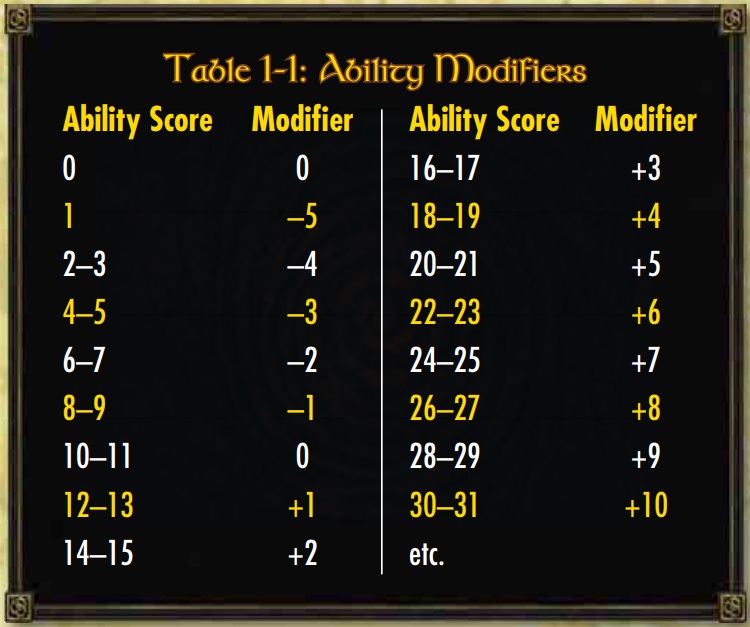
Every point of strength adds 15lbs to carrying capacity for medium sized creatures. Small creatures can only carry 10lbs per point of strength, and large creatures can carry 20lbs per point of strength. A dwarf, human, and tauren with 12 strength can therefore hold 120lbs, 180lbs, and 240lbs respectively. A character can drag as much as 5 times his maximum load.Core stats follow these modifier scores:
Armor stuff like nat armor
How does will/reflex/fort saves work?
Other skills?
Evasion and Aborption are both active defenses. That means unless ready for combat they are ignored and you are considered flat-footed.
Combat
You are considered "in combat" when an enemy is attacking or chasing you. Combat does not necessarily begin if an enemy notices you. When combat begins you roll an initiative roll (d20 + agility modifier) with a tie breaker roll of 1d100 if two or more characters roll the same initiative. Combat rounds go in order from highest initiative to lowest initiative. Combat ends when all enemies are deceased, stop chasing you, or are fleeing and you do not intend to continue combat by chasing after them.
If you get attacked while not ready for combat, a surprise round by the attackers occurs and for 1 turn you cannot attack and cannot use active defenses.
Each round is 6 seconds in "real time". This means there are 6 seconds to perform your actions or for effects. However offensive spells are augmented by the Haste stat (see Haste below).
Actions that can be performed are as follows:
Free Actions: Free actions can be used at any time as long as you have control of your character (see loss of control below). Free actions include speaking.
Instant Actions: Instant actions are similar to free actions, however cannot be used while concentrating on a spell or ability. Instant actions include drawing a weapon and certain spells.
Move Actions: Movement can only be used during your turn. Movement takes time, however you may specify exactly how much time you use to move. Each race has a specific movement speed listed per second.
Timed Actions: Timed actions can only be used during your turn. Timed actions take a set amount of time to cast or perform. Most spells and abilities take time, and will be noted in the spell or ability.
Each round can be split in any way the character likes. For example in 6 seconds if a character has one 1 second spell, one 3 second spell, and movement the person can:
- Cast the 1 second spell six times
- Cast the 3 second spell twice
- Cast the 3 second spell once and the 1 second spell three times
- Move for 6 seconds straight
- Cast two 1 second spells, move for 4 seconds
- Move for 2 seconds, cast a 3 second spell and move for 1 second
- So on and so forth...
There is no restriction on order: A character can do any ability in any order and can move before attacking or move after attacking.
Most spells and abilities can be used in or out of combat. Certain spells and abilities require you to be out of combat or in combat to use but are specified in the spell.
Haste
Each haste grants 1 extra second in your turn for offensive attacks. This does not actually change the amount of time in the round but simply allows you to cast more within the same time period. If an effect lasts 6 seconds, it lasts the full round regardless of your haste. A person with 4 haste therefore now can cast up to 10 seconds worth of spells, abilities, and can move for 10 seconds, however if stunned for 6 seconds, he misses the full round.
Cooldowns are not affected by haste whatsoever. A cooldown which takes 2 minutes takes exactly 120 / 6 = 20 turns.
Concentration
CONC RULES GO HERE
Cooldowns
COOLDOWN RULES GO HERE
Readying and Delaying
By choosing to delay, a character takes no action and then acts normally on whatever initiative count he decides to act. When he delays, the character voluntarily reduces his own initiative result for the rest of the combat. When the character’s new, lower initiative count comes up later in the round, he can act normally. The character can specify this new initiative result, or wait until later in the round to act, thus fi xing his new initiative count at that point. A character never gets back the time spent waiting to see what will happen. He also can’t interrupt anyone else’s action (as he can with a readied action).
Initiative Consequences of Delaying: The character’s new initiative result is the count on which he takes the delayed action. If he comes to his next turn and has not yet performed an action, he doesn’t get to take a delayed action (though he can delay again). If a character takes a delayed action in the next round, before his regular turn comes up, his initiative count rises to that new point in the order of battle, and he doesn’t get his regular action that round.
The ready action lets a character prepare to take an action after her turn is over but before her next turn begins. Readying is a standard action. It does not provoke an attack of opportunity (though the action that is readied might do so). Readying an Action: A character can ready a standard, move or free action. To do so, she specifi es the action she will take and the conditions under which she will take it. Then any time before her next action, she can take the readied action in response to those conditions. The action occurs just before the action that triggers it. If the triggered action is part of an ally’s or enemy’s activities, that ally or enemy’s action is interrupted. Assuming the ally or enemy remains capable of doing so, he continues his actions once the character completes the readied action. The character’s initiative result changes. For the rest of the encounter, the character’s initiative result is the count on which she took the readied action, and she acts immediately ahead of the ally or enemy whose action triggered her readied action. Characters can take a 5-foot step as part of their readied actions, but only if they don’t otherwise move any distance during the round.
Initiative Consequences of Readying: The character’s new initiative result is the count on which she takes the readied action. If she comes to her next turn and has not performed her readied action, she can’t take the readied action (though she can ready the same action again). If she takes her readied action in the next round, before her regular turn, her initiative count rises to that new point in the order of battle, and she doesn’t get her regular action that round.
Non-lethal Damage
Certain attacks deal non-lethal damage. This kind of damage won't kill them, however it does hurt and it can knock them unconcious. When a character takes non-lethal damage, subtract it from their current health points. If the "killing blow" is dealt with non-lethal damage, instead of dying, a character is instead knocked unconcious. An unconcious person will wake up after 30 minutes with 1 health and will heal at their normal regeneration rate after.
Attacks of Opportunity
If you are within 5 feet of an enemy and that enemy begins to retreat you may have an additional half your round (3 seconds + half your haste not rounded) to attack the enemy unless they perform a 5 foot step. See misc abilities.
Loss of Control
Some spells and abilities may make you lose control of your character. These come in the forms of stuns, fears, dazed, blinds & deafeners, and snares & entrapments.
Stun:
Fear: While feared, you begin to run away in a random direction or stand still paralyzed with fear depending on the spell effect. Fear effects completely override your ability to move your character and may even cause injury or death even when otherwise avoidable (such as being feared off a cliff). You may still attack if it possible for you to do so, but depending on the spell your full turn may be used to run away.
Daze:
Blind & Deaf:
Snare & Entrapment: Snares are effects which slow your movement speed down and may affect your haste. They are similar to difficult terrain in other systems. Entrapments on the other hand completely stop movement all together and must be fought out of (or waited out of) to escape.
Every effect can be countered by at least one spell or ability. Counters can be used even while you have lost control of your character for that specific effect. For example [Every Man For Himself], the human racial, can be used while stunned to remove stuns, but cannot be used for example while blind.
Class Resources
Rage: The simplest system. The more damage you do, the more rage you get. The more damage you take, the more rage you get. Starting at 0 rage, every 10 points of damage dealt or taken gives you +(1 + your strength modifier) rage up to your maximum rage level (see class rage table). Your rage deteriorates outside of combat and will fall back down to 0 at [2 * (1 + your strength modifier)] rage per round as you calm down. Some abilities will use up a certain amount of rage; abilities cannot be used unless you have exactly that much rage or more and is subtracted from your rage once used. There are some rage generating abilities upon start of combat so you shouldn't be starved of rage at the start of fights.
Energy: Starting at your maximum energy level (see class energy table), you expend energy by performing abilities that use energy and regain energy by not performing an action which consumed energy for that turn. Every round you do not expend energy you gain +(5 + agility modifier) energy. Not all abilities require energy. You can choose to take a full round rest action, not moving or using any spell/ability at all to triple this [3 * (5 + agility modifier)]. Outside of combat, your energy will return back to your maximum at twice your in combat rate [2 * (5 + agility modifier)]. Some abilities will consume a certain amount of energy; abilities cannot be used unless you have exactly that much energy or more and is subtracted from your energy onced used. Note that energy is considered a class resource only, so things like running do not consume any energy.
Mana: Starting at your maximum mana level (see class mana table), you expend mana by casting spells which use mana and regain mana by not performing an action which consumes mana for that turn. Every round you do not expend mana you will gain +(5 + your intellect modifier) mana. You can choose to take a full round rest action, not moving or using any spell/ability at all to triple this [3 * (5 + intellect modifier)]. Your mana will return back to your maximum at twice your normal rate per round [2 * (5 + intellect modifier)] per round outside of combat. Most spells can be cast at a lower power for lesser amounts of mana than listed or at a greater power for more mana. Cast time, damage/healing, and mana cost is proportional to how much mana you wish to use. For example a spell which costs 10 mana, takes 6 seconds, and deals 60 damage when cast with 2 mana will take 1.2 seconds and will deal 12 damage. The same spell with 20 mana will take 12 seconds and deal 120 damage. Mana can only be expended in whole numbers. However when casting a spell at a different mana level, it may cause different effects or none at all with too low mana. A spell that deals damage and stuns a target for example may only stun at 100% mana or more while any lower may only deal damage. Some spells have certain effects which only occur at higher mana costs than their base effect (see each spell description for details). Certain spells, such as Rituals require the full spell to be cast and cannot be cast with less mana and have no effect with more mana. You may assume all spells can be cast with less or more mana unless otherwise noted in the spell itself or is a Ritual. This serves two purposes: eliminating spell slots/spell levels and allowing mana users to be a lot more versatile.
Health Points: When you take damage you subtract it from your HP. There are some healing spells which may, in and out of combat, heal you for a specified amount. Outside of combat your Health Points automatically regenerate at +(1 + your stamina modifier) per round. When your HP hits 0, you die. However if a resurrection spell is cast upon you within a certain time period you can be revived. Only certain classes have resurrection spells and they themselves come with certain restrictions. Every minute which passes reduces the chance of a successful resurrection and it diminishes greatly. The chance of spell failure is 3 raised to the power of how many minutes have past. That means if cast immediately there is a 0% chance of failure, after 1 minute it is 1% chance of failure, 2 minutes is 2%, 3 minutes is 4%, then 8%, 16%, 32%, 64%, then 100% chance of failure at the 8 minute mark. A character is considered long gone after this point; the character's spirit has left the body. There may be other ways to bring a spirit back to a body...regardless of who's body it is...
Misc
Specializations
Every class has two specializations. Each specialization Mounts Fatigue, sickened Darkvision is the extraordinary ability to see with no light source at all, out to a range specifi ed for the creature. Darkvision is black and white (colors cannot be discerned). It does not allow characters to see anything they couldn’t see otherwise — invisible objects remain invisible, and illusions remain what they seem to be. Likewise, darkvision subjects a creature to gaze attacks normally. The presence of light does not spoil darkvision. Characters with low-light vision can see twice as far as normal in dim light. Lowlight vision is color vision. A spellcaster with low-light vision can read a scroll as long as even the tiniest candle is next to her as a light source. A character with low-light vision can see outdoors on a moonlit night as well as she can see during the day. +1 core score per level
Starting off and Leveling
Step 1: Choose a race Step 2: Choose a class Step 3: Roll ability scores: 4d6 drop 1 Step 4: Determine character's statistics Step 4: Equip the characterCast Time: 3 Seconds
Allows you to move outside of the melee range of an enemy without provoking an attack of opportunity.